Sandra's Story - Ibiza, Spain (December 1966)
Ibiza, Spain (December 1966)
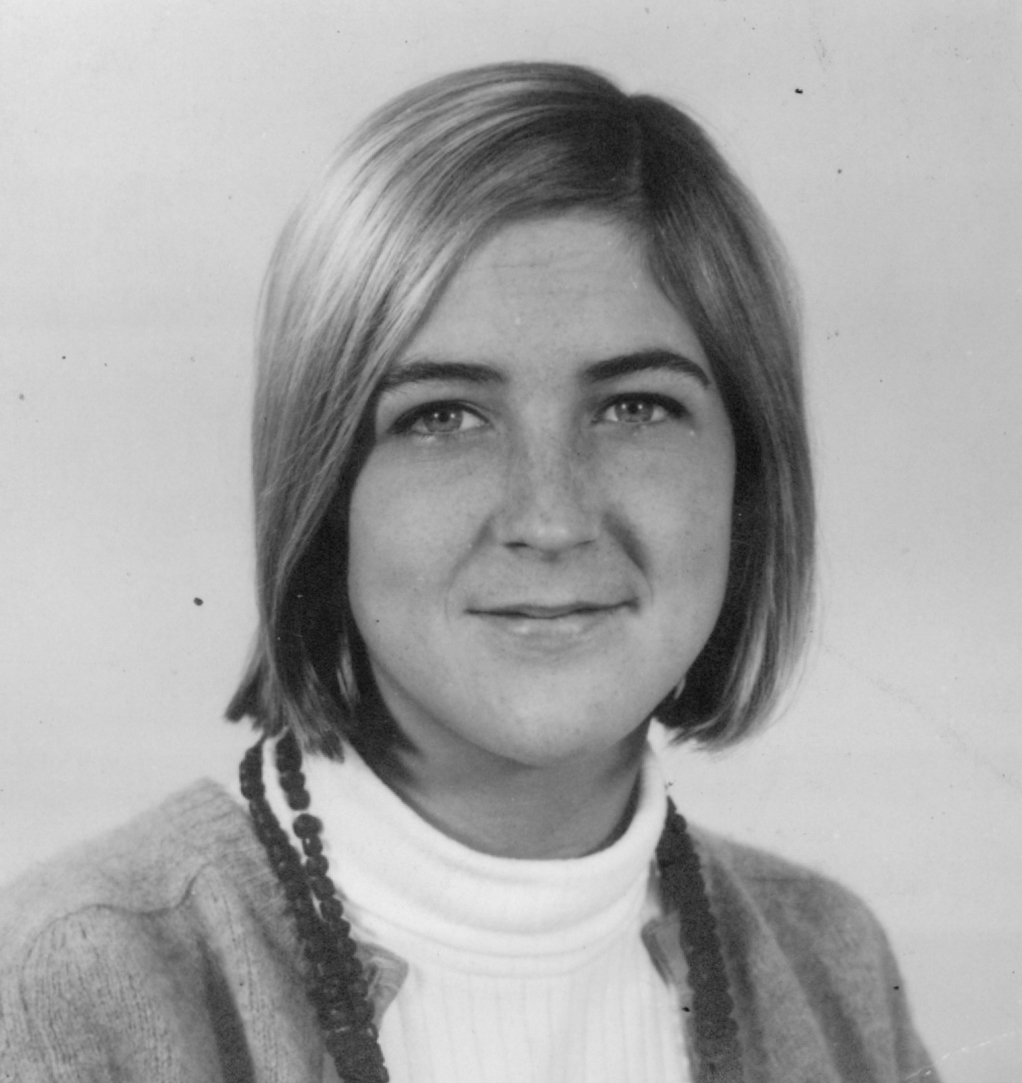
Following her advice, Sandra and her class-mate took the ferry from Barcelona to Ibiza. Below is a photo of Sandra taken in about the fall of 1966.
Soon after they arrived in Ibiza, Sandra and her friend were sitting in a café when they were approached by two German artists who introduced themselves as Immo Jalass and Peter Kubina. For a brief time, Peter, whom a local gallery owner, Ivan Spence, pictured below, had invited to camp out in his half-built home in Ibiza, and Immo, had exchanged houses.
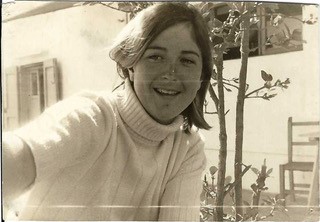
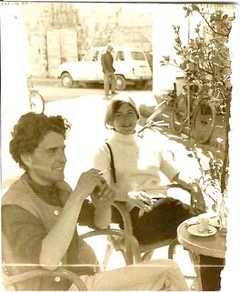
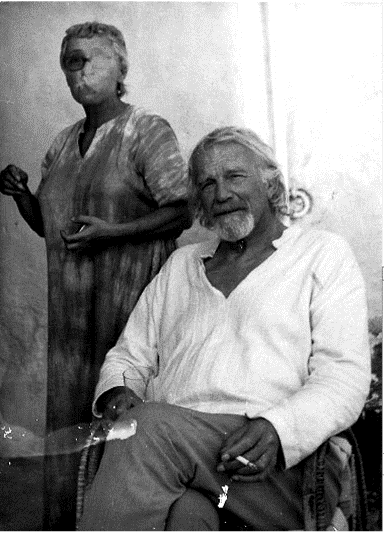
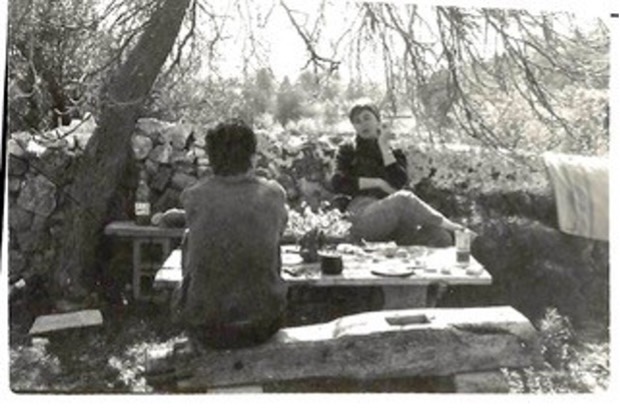
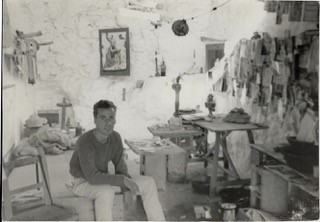
Immo Jalass, whose photo is below, was a self-taught artist, whose later work from 2000 onward used digital images. Immo was born in Hamburg, Germany, in 1938. He was 28, two years older than Peter, and six years older than Sandra, then 22 years old. By 1966, he had shown his drawings and oil paintings at exhibits at the Esplanade of the Bauzentrum in Hamburg (in 1962), had shown his drawings at a Gallery in Dordrecht, the Netherlands (in 1963), and his oil paintings at the Galerie Burdeke, in Zurich and Schweiz, Switzerland (in 1965), and was currently exhibiting his oil paintings at the Galerie Ivan Spence in Ibiza.
Context: Peter Kubina was born on September 11, 1940, in Biesnitz in the district of Schlesien in what later became East Germany. In an autobiographical essay that Peter wrote in 1963 and 64, in support of his application to study at the Art Academy in Munich (“Peter’s 1964 autobiography”), Peter wrote that he had a document that recorded that Mrs. Schmechtig had given birth to a boy on 9-11-40 in Biesnitz. Biesnitz was a suburb of Germany’s easternmost town of Gorlitz, situated southeast of Berlin and northeast of Munich. Peter said that he had no document (or that no such document existed) about his father, but later added that in 1961, he had found a paper with the name of his father, which was Kubina. He said that he had never met his biological mother or father, but when in art school and later, on his arrival in the U.S., he took the surname Kubina.
In his 1964 autobiography, Peter wrote that he believed that he was adopted at the age of 18 months by Ruth (nee Krinssik) and Erwin Pfeiffer, who were Evangelical Lutherans. They also adopted an unrelated baby girl. Peter wrote that the Pfeiffers had not been members of the [Nazi] Party, but his adopted father was obliged to serve in the military.
In 1945, when Peter was 5 years old, his adopted parents and Peter, along with other families, escaped the Russian invasion, taking a train to southern Germany, where they settled in Germany’s southernmost town of Lindenberg in Allgäu, Bavaria.
In his autobiography, Peter said that in 1945, during his family’s escape by train to the south of Germany, he had seen, at night, two totally bombed cities, Munich and Dresden, in each of which his family had spent a night. They continued in the morning and eventually arrived in Weiler, in Allgau county, east of Lake Konstanz (Bodensee) in the foothills of the Alps, near Germany’s border with Switzerland, to the west, Liechtenstein to the south, and Austria to the east.
Peter’s adopted parents later were able to have a biological child, a son, Ulrich, who was 8 years younger than Peter. Peter always felt that his parents showed preference towards Ulrich.
When Peter was 11 years old, his stepparents told him that they were not his biological parents. Peter never elaborated on the circumstances of this revelation, but it may be supposed that he had issues with his adoptive parents, as he later took the name of his biological father, whom he never met, and after his graduation from high school, apparently had no further contact with the Pfeiffers.
Peter attended a combination high school/college called Oberreal Schule (Oberreal School) in Lindenberg, about 12 kms north of Weiler, where his adoptive father was Dean of Physics and Mathematics and Peter’s adoptive parents’ younger son also later attended. When Peter was 16 years old, the students at the school were shown a documentary film of the Holocaust, which was made by a Canadian film crew following the victorious US army into Germany. Peter later wrote, in his 1964 autobiography, that he still considered Dwight Eisenhower to be the most important General of the 20th Century.
Peter received some art instruction at Oberreal Schule, some of whose students went on to university or to art school. In his autobiography, Peter wrote that he copied mostly drawn birds from a biology book and made 100 small animal sculptures, from 3-inch-high elephants to little mice, as naturalistic as possible. Three years later, he wrote stories, strange enough to make the adults wonder.
Peter wrote that his regular activities in sport (running, cross country skiing) and art helped him crawl out of his “invented ‘psychological mud hole’” and to look out for good individuals to learn from.
Peter graduated from Oberreal Schule in 1960, at the age of 19. He then entered the German military, where he served his 18 months of compulsory service. In 1962, he entered the reserves with the rank of Second Lieutenant. He later wrote in his autobiography that on completing his military service, he believed that Russia would never again attack Western Europe and that Germany should remain neutral and not produce armaments for sale. As a second choice, he thought, Germany should align itself with the USA and the surrounding countries of Western Europe.
In October 1962, Peter began the study of Geography and Economics at Maximilian University in Munich, and took evening courses for the entrance exam for the Academy for the Development of the Arts in Munich. He later wrote in his autobiography that, lacking any interest in family, political or religious activities, he decided to focus on making drawings and sculptures, and to make a living making art.
Peter later described the years from 1962 to 1967 as his “grass-hopper” years, referring to the American television series, Kung Fu, broadcast from 1972 to 1975, in which an orphaned child of an American father and Chinese mother enters a Shaolin Monastery where he is given the name “grass-hopper” by his mentor, and receives spiritual and martial arts training. Peter wrote that in 1961, he was in Munich, working for a construction company, when he wrote the entry test for enrollment in the University and its attached Art Academy. After failing the test at that time, he consulted the teacher whom he considered to be the only qualified artist at the school, who referred him to Adolf Vallazza, in the Town of Ortisei, near Bolzano in the Dolamites, in northern Italy. The Dolamites, also known as the Dolomite Alps, are a mountain range in northeastern Italy, about a five-hour drive south from Lindenberg, where Peter had attended school, on the opposite side of Liechtenstein. There, on May 3, 1963, Peter became the apprentice of Adolf Vallazzo, a master wood sculptor, in whose studio he spent the next two years learning proper woodcarving.
Peter later wrote that he could not have found better teachers and friends than Adolf Vallazza and his brother Markus. In this Dolomite village, he wrote, he felt at home: skiing, mountain climbing, woodcarving, drawing and receiving a “mind-opening” education in Italian and Modern Art.
Context: Adolf Vallazza was born in 1924 in Ortisei, in South Tyrol, the autonomous, northernmost province of Italy. His father was an iron sculptor and his mother was the daughter of Josef Moroder Lusenberg, a painter. After his studies, between 1947 and 1957, Vallazza opened his own atelier in Ortisei and married Renata Giovannini, with whom he had four children. In the early 60s, his first exhibitions appeared in Italy and abroad. In 1968, well-known critics, including Garibaldo Marussi, Luciano Budigna, and Giorgio Mascherpa, brought Vallazzo’s studio to public attention and in the 70s, Vallazzo collaborated with the German architect, Neckenik from Neuwied, who assigned him many monumental works for churches and public places. Peter described having received an invaluable piece of advice from Adolf after a night of drinking. Adolf warned Peter to never compromise the integrity of his art in exchange for commercial success, because once done, it was virtually impossible to turn back.
In 1964, Peter returned to Munich, where he again wrote the entrance test for the Art Academy of Munich, part of the University of Munich. This time, he says, he was able to pass “with his eyes closed”. At the Art Academy, Peter received instruction from Professor Heinrich Kirchner, who influenced Peter’s later work in bronze sculpting.
Context: Professor Heinrich Kirchner, was 65 years old when Peter attended the Art Academy in 1964. He was a modern sculptor and bronze-casting expert, not related to the painter Kirchner. He had been the director of workshops for bronze casting at the Art Academy in 1932. During World War II, he refused to make Nazi-style art and was therefore sent by train to a labor camp. He escaped and was able to hide until the end of the War. After the war, he became interested in eastern spirituality. He was made a professor at the Academy in 1952. Kirchner’s fame grew after this period, and he became known especially for monumental sculptures, including the ones pictured below, from the Sanlingarten public garden in front of the Culture and Congress Centre (Kultur & Kongresszentrum, or Ku’Ko), in the City of Rosenheim in Bavaria, southern Germany.
Peter’s landlord in Munich was Dr. Sperr, a psychiatrist. After the war, he testified in court as an expert witness concerning the mental state of former Nazi criminals. Peter asked him if he observed evidence of the prisoners’ guilt, and he replied, “All”. He told Peter that during the war, his duty was to be in a transport plane filled with parachute soldiers, amid the smell of their vomit and excrement, flying over Crete, while the English soldiers were waiting on the ground. Dr. Sperr was the only person who ever spoke to Peter about ‘his time’ during the war. He bought two of Peter’s sculptures, one for the grave of his fallen brother.
On several occasions, Dr. Sperr gave Peter one of his ‘nervous breakdown’ patients, and asked him to make an artwork with them as part of their therapy. Peter later recalled that the project worked very well, when the patient was open to this kind of treatment. Peter’s approach was to have the patient make a head or hand.
After about a year, Professor Kirchner told Peter that he thought he really had learned all he could in the Academy, and recommended that he now devote himself fully to making art. Peter decided to live somewhere in isolation, to find himself and develop his art. A friend recommended the Spanish island of Ibiza, 81 miles off the east coast of Spain. At that time, in 1965, Ibiza was quiet. This was two years before it was discovered by tourists who soon overran the island and changed its character.
On Peter’s arrival on Ibiza, a South African named Ivan Spence, who had created and owned the first art gallery in Ibiza, invited Peter to live rent free in his unused, half-built, self-constructed country house outside of San Carlos.
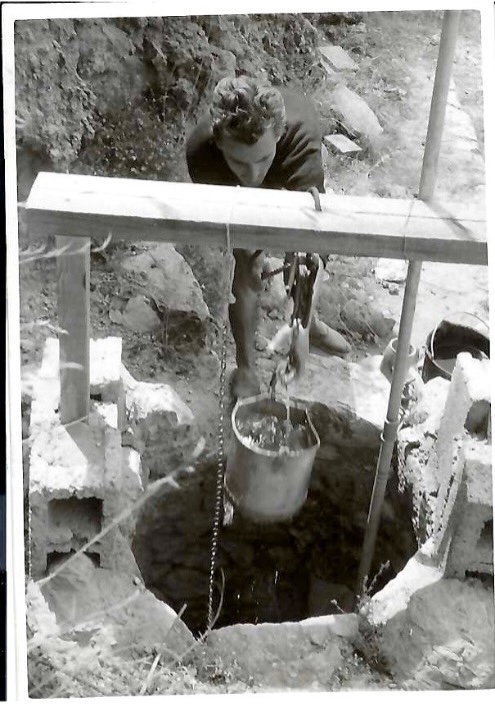
The isolated property had a deep fresh-water well. Peter spent a year and a half at Spence’s house. Below is a photo of Peter drawing water from the well at Ivan Spence’s house in Ibiza. During his stay there, Peter made some large sculptures, hand-made with cement and sand, which he later left behind.
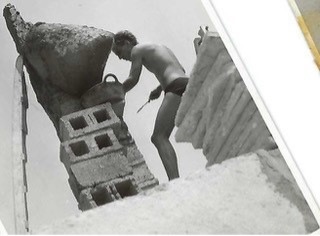
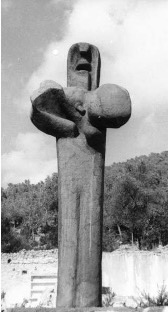
Shown above is Peter building a concrete sculpture and, below right, one of Peter’s concrete sculptures, “Mother and Child,” which he sculpted for Ivan on his property in Ibiza. The theme of mother and child has been a constantly recurring theme throughout Peter’s art.
When Sandra was living there, Peter mentioned borrowing a donkey from a neighbor to transport the cement for building the “Mother and Child” sculpture on the property. Peter and Sandra used mainly propane canisters for light and cooking.
Below is a photo taken of the sculpture in the yard of Ivan Spence’s house in Ibiza and, below that, a photo-shopped image that Peter later created of the same scene.
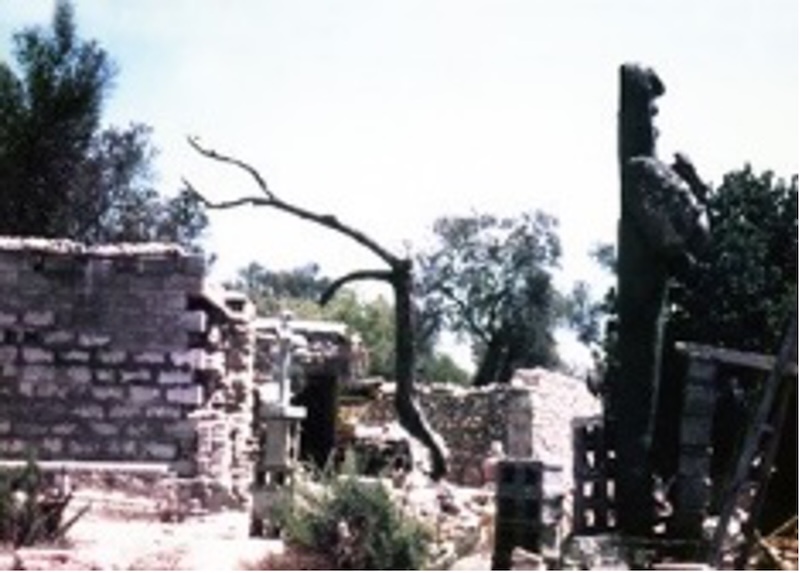
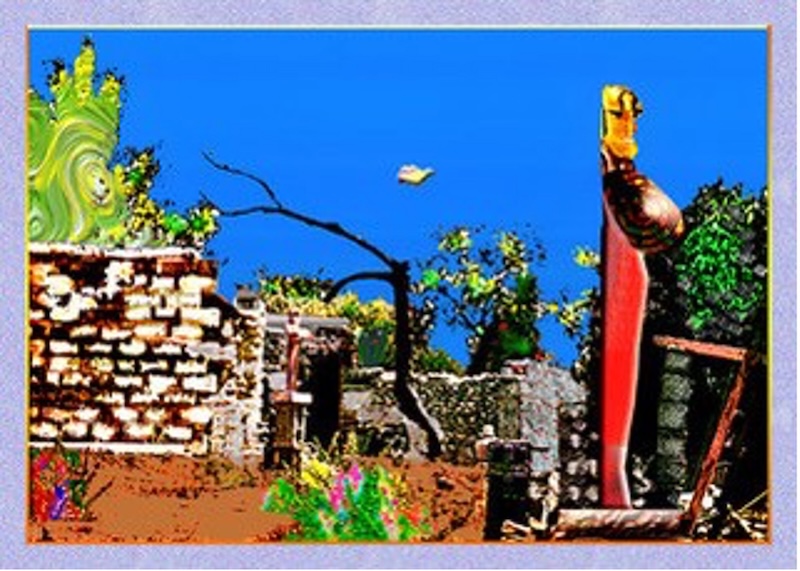
Peter found that he had plenty of time to make art and to get to know himself. To his surprise, he made more friends on Ibiza and one the nearby island of Formentera than he had had in Munich. Among those was Sandra.
Sandra returned to the University of Madrid, where she registered, after the mid-semester break, on November 7, 1966. Upon completing her first semester, Sandra boarded a flight on December 12, 1966, to return to New York for the Christmas break on a plane that NYU had chartered for foreign students enrolled in their program. Peter had no job at the time, but likely had a small amount left from what he had saved when he was a student in Munich. He didn’t ask Sandra for help, but the two of them made plans together and for a short time, Sandra shared the small amount of money she still had from what our mother and father had sent.
While in Ibiza, Sandra and Peter met a young Mexican student who was studying classical guitar with the Spanish virtuoso classical guitarist Andrés Segovia Torres, 1st Marquis of Salobreña (21 February 1893 – 2 June 1987). He observed that Peter’s small clay figurines and drawings for sculptures were reminiscent of the kind of pre-Columbian figurines that were a part of Mexico’s early indigenous culture. After researching more about pre-Columbian art, Peter and Sandra made a plan to travel to Mexico, so that Peter could see the pre-Columbian art first-hand, and could work on his art in that environment. As their money was running out, they agreed that Peter would return to Munich, and Sandra to mainland Spain, where they would develop a plan for Peter to come to the U.S.
Having spent a year and a half in Ibiza, Peter made his way to Barcelona, where a professional photographer invited him to drive with him from Barcelona to Paris and to meet him there one month later to drive back to Munich. Peter had 100 D-marks to spend. In Paris. He slept under a bridge, where he made friends with travelers from Canada, Algeria and other countries, young and intelligent, rich and poor. Peter had the address of the sculptor, Alberto Giacometti’s studio, where both Diego and Markus Vallaza worked. Giacometti was in London at the time of Peter’s visit, but Diego invited Peter to look around the studio. The space was full of clay, wax and plaster and contained some of Giacometti’s unfinished works. Some other plaster statues were outside. Peter later said that for him, it was like visiting a temple. Henry Moore and Alberto Giacometti were his favorite living artists. He later wrote that they were very different in style, but with the same high quality as artists.