Sandra's Story - Europe, (January to November 1967)
Europe, January to November 1967
After returning to New York after Christmas, Sandra took the NYU charter flight back to Madrid. She arrived at the Barajas-Madrid Airport on January 9, 1967, as appears from her passport. The second semester at the University of Madrid did not begin until February, so Sandra travelled to Ibiza, where she stayed with Peter. However, instead of returning to the University of Madrid in February, Sandra remained on Ibiza with Peter until their money ran out in early April.
In the meantime, Lucy had flown to Paris, where she worked for a large French corporation until April. Sandra left Ibiza on April 6, 1967, as it appears from a stamp on her passport, and she then travelled to Paris, where she met Lucy and was issued an international driver’s license on April 26, 1967. The two then drove together to the south of France, where they stayed at a convent for a night in Marseilles, arriving unexpectedly during a Gypsy convention. Sandra and Lucy continued on through the French countryside to Nice. While in Nice, they visited the Maeght Gallery of Modern Art in the restored medieval village of Saint-Paul-de-Vence above Nice. It is considered one of the best galleries of modern art in the world and during their visit, there was a splendid exhibition of Giacometti’s and Jean Arp’s work in a courtyard and around the museum, in addition to work by Chagall, Braque, and others.
Sandra and Lucy then drove down through Italy to Naples and Capri, and on to Corfu by ferry, on May 31, 1967, as appears from a stamp in Sandra’s passport. They drove around Greece, visited the island of Skiathos, and then drove north through Albania and Yugoslavia, and finally to Venice.
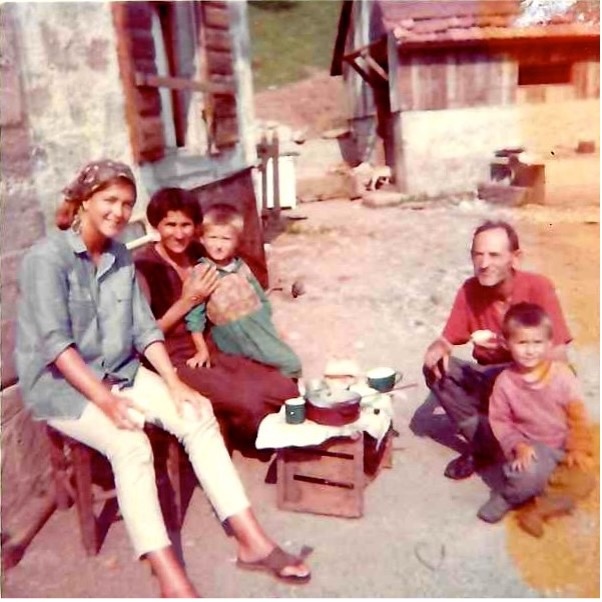
In some places, maps were not always up-to-date and in Yugoslavia, the road Lucy and Sandra were following simply ran out because of an unfinished construction project. Because night was falling, this impromptu stop required looking for a nearby place to put their sleeping bags that appeared to offer some semblance of safety. Lucy Barker took the photo at left of Sandra at the home of a very poor, but hospitable Yugoslavian family who allowed them to camp for a night in their barn yard.
By the time they arrived in Venice, Lucy had learned how to drive the stick-shift car. She returned to Paris to drop off the car, and Sandra returned to the University of Madrid where she telephoned our parents and informed them that she had decided to drop out of university and return to the U.S., where she hoped they would help her arrange for the entry of the German artist whom she had met in Ibiza and wanted to marry. Sandra collected her belongings and flew to Paris, where she met Lucy and they drove together to Sion, Switzerland, arriving there on July 31, 1967. From there, Sandra took a train to Munich, where she was able to get a work permit. She arrived in Munich on August 7, 1967, with a work permit that allowed her to remain there for two weeks and work until August 24, 1967.
In Munich, Sandra stayed with Peter, who had gotten a job in a little German hotel during Octoberfest that included room and board in as part of his salary. Sandra got a temporary job as a secretary in Munich, but did not speak German well enough to make it a permanent employment. Peter and Sandra stayed at his hotel and made plans to facilitate Peter’s travel to the U.S. so they could then travel to Mexico to study pre-Columbian art. Sandra returned to her parents’ home in Ft. Lauderdale, where they had retired from Ottawa. While there, she worked at various jobs and Leonard arranged for a visa for Peter and bought a ticket for his flight. Until those arrangements had been made, Peter continued to work in Munich. He later wrote:
“The most entertaining job I ever had was as a stagehand at the Opera house back in Munich. I had free up-close views of all operas, theatre plays and ballet performances on a three-story high stage. The audience was in a dark space. Most of the stagehands were students of the arts, musicians, writers, actors. I wanted to stay there, but a written invitation to visit Sandra and her family in the USA arrived.”
In 1967, on his way to the U.S., Peter traveled to Paris, where he visited the studio of Alberto Giacometti. Alberto Giacometti was then in London undergoing treatment for the illnesses that took his life later that year, but Diego, who took care of Alberto’s bronze casting, spent time with Peter and showed him around their studio.
After leaving Paris, Peter travelled to London England in the hope of meeting Henry Moore. On arrival in London, Peter telephoned Moore, whose secretary gave him an appointment for a short visit. After a bus ride from London to Much Hadham, Peter knocked on the door to Moore’s studio. He brought with him several sketch books and an album with photos of his sculptures. He also bought a large bouquet of flowers from the flower stand at the bus stop across the street. Moore’s wife was down with a cold, and he could hear her saying ‘not to let him in’. Nevertheless, Moore’s secretary took his flowers from his arm and let him enter. Henry Moore soon appeared, and invited Peter to come upstairs to his living room.
Moore looked at Peter’s portfolio of drawings. He said he liked the drawings. Looking at the photos of Peter’s sculptures, he pointed out that Peter had to learn to understand the dynamics of form language. “A face, a head, has soft and hard form details”. Peter later said that it took him years to reflect on what Moore had said. After reviewing Peter’s portfolio, Moore invited him for a walk on his property. Two young men were working on a large oak wood sculpture.
When the time for the appointment was up. Moore showed Peter his calendar booklet: “I have too many meetings to attend. Here is the small key to my studio. When you are finished, bring the key to my secretary”.
Walking back to Moore’s studio, Peter told Moore that he was on his way to the United States and to Mexico, where he wanted to see the pre-Columbian art there, and make sculptures in that environment. Moore had spent time in earlier years in Mexico, where he had incorporated pre-Columbian influences into his art. Moore gave Peter the name and contact information of a friend of his named Mathias Goeritz, who lived in Cuernavaca, and suggested that Peter contact him. He gave Peter a note to give to Goeritz. While shaking hands with Peter, Moore said that making art is more like a long-distance race than a sprint, and that many young American artists do not accept that.
Moments later, Peter found himself sitting inside Moore’s studio. He could see small, unfinished hand sized pieces, bone parts, sketches, and other works. For Moore, a small piece was like a large sculpture, seen from a distance.
Context: Henry Spencer Moore, (30 July 1898 – 31 August 1986), was an English artist best known for his semi-abstract, monumental bronze sculptures, located as public works of art around the world. He was 68 when Peter met him in 1966. Moore was born in Castelford, in Yorkshire, where his Irish father was a middle-manager of the Wheldale colliery. He was the seventh of eight children in a family that often struggled with poverty. He attended elementary school in Castleford, where he began modelling in clay and carving in wood. He later said that he decided to become a sculptor when he was eleven, after hearing of Michaelangelo’s works at a Sunday School class.
When Moore attended Castleford Secondary School, his headmaster noticed his talent and interest in medieval sculpture. His art teacher, Alice Gostick, broadened his knowledge of art, and with her encouragement, Moore determined to make art his career. On turning 18, he volunteered for army service in the first World War, where he was injured in a gas attack in 1917. After recovering, he spent the remainder of the war as a physical training instructor.
After the war, Moore received an ex-serviceman’s grant to continue his education and in 1919 he became a student at the Leeds School of Art (now Leeds Arts University), which set up a sculpture studio especially for him. In Leeds, in 1921, Moore won a scholarship to study at the Royal College of Art in London, along with several of his Yorkshire contemporaries. While in London, he broadened his knowledge of primitive art and sculpture, studying the ethnographic collections at the British Museum. In 1924, he won a six-month travelling scholarship which he spent in Northern Italy. During that period, he also visited Paris, took the timed-sketching classes at the Académie Colarossi, and viewed, in the Trocadero, a plaster cast of a Toltec-Maya sculptural form, the Chac Mool, which he had previously seen in book illustrations. The reclining figure had a profound effect on Moore’s work, becoming the primary motif of his sculpture.
In 1941, Moore settled in Much Hadham, and built is house, “Hoglands”, which is now part of a sculpture garden featuring his work, run by the Henry Moore Foundation. In the 1950’s, Moore began to receive increasingly significant commissions, exhibiting “Reclining Figure” at the Festival of Britain in 1951 and in 1958, producing a large marble reclining figure for the UNESCO building in Paris. With many more public works of art, he produced larger sculptures and began to employ an increasing number of assistants to work with him at Much Hadham.